Search

Do you ever find yourself wondering…

  • Why Unilever, Coca-Cola, BP and other leading players are diluting their sustainability targets?
  • Why stakeholders are pushing back against ESG, including the European Union’s leading approach to disclosure?
  • Why, despite 50 years of commitment to sustainable development and trillions ‘tilted’ towards sustainable investment, key global indicators are still heading in the wrong direction?

Is it simply corporate intransigence? Are we practitioners not working hard or smart enough? Maybe the deeper problem lies in the nature of the transition itself.

What if the tools that got us here are not the ones we need to achieve the desired change?

Incite invites you to Embracing Complex Transitions, an advanced retreat where you will join fellow sustainability practitioners in exploring effective ways forward on all these issues, and more.

This two-day residential intensive offers a practical introduction to using complexity-adapted tools to enhance sustainability integration and practice.

You will leave with:

  • A deeper understanding of complexity and what it means for sustainability practice
  • Practical complexity fit tools to support sustainability strategy, innovation and stakeholder engagement
  • Insight into how these are being applied to accelerate sustainability transition amongst your peers
  • An extended network of practitioners who seek more effective ways to bring about the sustainability transition.

Join us at the historic Mont Fleur Conference Venue in Stellenbosch.

Space is limited to 20 people. Booking opens 6 January 2025.

Full Fee R18,000 ex VAT. Early bird rate of R16,000 ex VAT ends 31 January 2025.

The retreat will run over two full days, starting Monday 3 March 2025 at 10:00 and ending at the same time on 5 March 2025. It is residential and all-inclusive.

Download the draft programme here: Incite-Retreat-2025-programme-6Jan2025

Facilitators:

Jonathon Hanks (Incite)

Nicola Robins (Incite)

Guest presenter Donna Glanvill (The Cynefin Co)

Panels will include leading global and local experts. The facilitators will be available until lunchtime on the 5th for open discussion and consultation.

Registration and admin enquiries: Please email Treve Jenkin.

Programme enquiries: Please email Nicola Robins.

Even before this eventful week, the handwringing was getting more palpable. Announcing one’s return to traditional religion has become almost commonplace.  ‘Where will this lead…?’ or ‘How could it have come to this…?’ But when things are entangled, we can’t really say whether an election or some other event will deliver good or bad, ultimately. In the same vein, we can’t really pin the blame on anything. Systemic entanglement is not a new thing. If we paid more attention to the past, we would know more about it.

Africa’s longest defence against colonialism was fought by the Eastern Cape Xhosa against the British Empire. Despite vastly inferior war tech, they resisted the British for 100 years in a series of brutal frontier wars that ended in the late 1800s.

A young Xhosa girl named Nongqawuse was orphaned during the Eighth Frontier War, and went to live with her uncle Mhlakaza, a diviner. When she was 15, she and a friend went to chase birds from the crops, and claimed to see the spirits of the ancestors. Returning home, Nongqawuse told her uncle what the spirits had told her.

To win the war, the people should destroy all their crops and slaughter every head of cattle (the source of wealth as well as food). In return, the spirits promised to sweep the European settlers into the sea. Granaries would be replenished, and the cattle would be replaced with healthier herds.

For her uncle, just enough of her story rung true. The cattle were plagued by a lung disease that had arrived with the European livestock. He took the prophecy to the Xhosa king, who issued a command. A millenarian movement erupted across the nation and in a frenzy 400,000 head of cattle were slaughtered and acres of crops were burnt.

Tens of thousands starved or were felled by disease that emanated from the rotting carcasses. By 1879, the long-running resistance to British rule collapsed and the British colonial authorities expropriated Xhosa land.

Every South African child is told the tragic story of Nongqawuse. Some say it shows the danger of primitive beliefs in prophecies or the idea that we can foretell the future.

But the deeper lessons lie between the lines. They lie in the fact that 100 years of colonial war had deeply disrupted Xhosa society, including cultural practices that were seen to bring a return to ‘order’. When disruption becomes systemic, blame flies every which way.

  • For more than a year, the failure of Nongqawuse’s prophecy was blamed on those who resisted the call, dubbed the amagogotya (‘those who refused to believe or obey a prophet’).
  • Oral traditions attributed blame to Nongqawuse herself.
  • Feminist historians blamed her uncle and the chief for taking her visions out of context.
  • The liberals blamed backward thinking, and offered Nongqawuse shelter.
  • The Marxists saw it as a plot by British colonial governor and arch-tactician Sir George Grey to manipulate the situation.
  • Writing in 1888, Gqoba, a linguist with a vernacular understanding of the era, blamed the Christian influence on Nongqawuse’s uncle.
  • Nongqawuse herself had equated Governor Grey with Satan.

In their paper on Nongqawuse, economic historians Helen Bradford and Msokoli Qotole acknowledge the futility of blame in the context of a peasant world view disintegrating in the face of a capitalising colonial order.

More than a century on, does something feel familiar? When disruption becomes systemic, it is no longer possible to ascertain root cause; and we can assume very little about what will happen next. Things have moved beyond the known order and nonlinear dynamics take centre stage.

When spirits wake up, deeper patterns are in play.

___

Source: Helen Bradford and Msokoli Qotole. 2008. Ingxoxo enkulu ngoNongqawuse (a great debate about Nongqawuse’s era). Kronos vol.34 n.1 Cape Town Nov. 2008.

Image of Nongqawuse: https://en.wikipedia.org/wiki/Nongqawuse


It’s happening!

Incite’s occasional deep training retreat returns on 3-5 March 2025, to Mont Fleur Conference Venue in Stellenbosch.

  • Expect insight into how complexity science can support your organisation’s sustainability transition.
  • Expect updates on developments in sustainability disclosure, strategy methods and transition governance systems.
  • Expect facilitated processes and embodied learning, with no fluff.
  • Expect ample space to share your own insights into what works and what doesn’t.

Join us as we tackle tough topics and celebrate our humanity as practitioners in an Age of Uncertainty.

Special guest and co-presenter is Donna Glanvill who leads learning and training for The Cynefin Co. Donna is a consultant, thinking partner and facilitator specialising in complex contexts. The Cynefin Company is an action research and development hub working at the limits of applied complexity science.

The Incite team will be there too.

It promises to be extraordinary. We look forward to welcoming you.

Please get in touch with Treve to register your interest or intention: treve@incite.co.za


Why do we know so much about ubuntu and so little about the traditional knowledge system to which it belongs? In a word: history. The discovery of gold and diamonds in South Africa in the late 1800s catalysed a particular expression of colonialism.

Generally speaking, colonialism imposes neoliberal ideology; settler colonialism forces it deep into the heart of society. The pattern of settler colonialism is to extract and reinterpret to reinforce its domination and control. This pattern was in large part what made ubuntu so accessible to westerners.

Ubuntu is typically translated as “I am because we are”.

  • In intellectual circles, ubuntu is used in counterpoint to “I think, therefore I am”, as proposed by 17th century French philosopher René Descartes.
  • In the business world, ubuntu became another name for servant leadership.
  • In the tech world, it lent its name to an open source Linux-based operating system.

In general, it took on whatever form was needed to reflect a warmer and perhaps better way to conceptualise humanity. The growing popularity of ubuntu was largely responsible for obscuring the broader knowledge system to which it belongs.

Ubuntu was extracted from a vast network of traditional knowledge systems that still pervades the sub-continent. Highly pragmatic and syncretic, it is called Ngoma. It forms a vast network of traditional knowledge systems that still pervade the sub-continent.

The popularisation of ubuntu was a political decision. At the dawn of South Africa’s democracy in the mid-1990s, people had endured decades of brutal liberation war. Although things were looking up, they were still teetering and had the possibility of descending into a bloodbath. Mandela wanted to avoid that. He asked a wise and wonderful man called Desmond Tutu to chair a Truth and Reconciliation Commission.

As an Anglican archbishop, Tutu was highly trained in Christian theology. He also had a deep understanding of ubuntu. He took on a big task for the country, and used ubuntu to do it. In the process, he popularised an interpretation of ubuntu that was highly consistent with ‘turning the other cheek’.

South Africa became a Good News story and ubuntu became so accessible to Westerners that the more complex system of Ngoma fell by the wayside. Many people were happy to reinterpret and embrace ubuntu while still seeing the rest of African traditional knowledge as backwards or superstitious.

The complex African knowledge system from which ubuntu was extracted embraces ambiguity in a way that makes many Westerners uncomfortable. Anthropology literature aside, Ngoma does not lend itself to popularity beyond the continent.

Through the lens of epistemic justice, we might see Ngoma as a powerful response to uncertainty. Recognising a world where agency is hyper-distributed, it adapts and blends, switching between levels of granularity and fluid identities to accommodate the new. In making sense of uncertainty, its expert practitioners apply random simulation, deep pattern analysis and abductive logic to help people at any level of society find a way forward. In theory, it’s a bit of a mouthful; Ngoma is largely about practice.

I am obviously offering another interpretation, based primarily on complexity science. But in doing so, I have tried hard to avoid extracting traditional concepts to feed a world hungry for indigenous ideas. Whether intentionally or not, that repeats the pattern of settler colonialism.

When we work with the fundamentals, we work with power. We are on a knife’s edge. There is always more to learn.

___

I have explored how to apply the traditional science of Ngoma to support the sustainability transition for more than 20 years. For several reasons (which I am happy to discuss), I have avoided making my explorations explicit until recently. I have just finished a reasonably coherent draft of a book on this 20 year journey. It has taken 18 months to write and I promise to publish it next year! Incite provides the space for me to do this work, but the application of traditional African knowledge to sustainability transition is limited to my own engagements; it is complementary but does not form a part of Incite’s core offerings.

Banner pic cropped from a photo by Hanien Conradie.

Over the past few millennia, our relational intelligence has taken a beating. This makes materiality analysis interesting. It allows consultants to make a killing.

Annual reports should be concise, but stakeholders need a reasonably full picture to inform their decisions. Materiality analysis is how they find a balance. It requires teams to consider and agree what actually mattered during the reporting year. Reports should also be forward-looking, so materiality analysis is informed by trends i.e. those matters that are likely to remain or become more important going forward.

At one level, what mattered seems obvious to anyone deeply familiar with the business. Every executive has a view of what mattered. Every manager knows what mattered within their area of responsibility. Every employee has a valid view too. They were there, day in and day out. Their bodies accumulated data on what mattered every millisecond. We naturally track trends. What makes materiality seem obvious to some is intuition.

At another level, the question of what matters is complex. This does not conflict with it seeming obvious to some. The problem only arises when we are asked to make the materiality process explicit. That usually means a set of simple steps. Complexity science tells us that problems arise when we impose linear methods (e.g. a set of simple steps) on a complex system (e.g. executive intuition). Our intuition just became shy.

At the base of the problem is the fact that materiality is relational. What matters depends. It depends on what happened. It depends on how our business model might have changed. It depends on what people think is important at any given time. Mainly, it depends on who is reading the report and what decisions they seek to make. Despite what the ESG raters say, it’s just not as simple as splitting a list of topics into material vs not material.

When categories become fluid, Westerners get worried. There’s cognitive legacy here. Colonial scientists destroyed local knowledge that had been accumulated over millennia because it did not accord with their categories. San hunters, for example, can categorise animals based on where they find their food. Makes sense to a hunter; sounds primitive to a colonial scientist who knows that The Best Way to categorise animals is called species and based on genetics. The San were more interested in relationships: their categorisation was more complex and did not require killing large numbers of animals to work out. But I digress.

As materiality became encoded in reporting standards, disclosure teams began to face a dreadful problem: no one seemed to know The Best Way to do it.

For a while, reporting teams got around the problem by creating pseudo-processes to validate what seemed obvious to them. A plethora of 2×2 matrices emerged that ‘rated’ issues on (x) their importance to the organisation and (y) their importance to stakeholders, and variations on this theme. Elaine Cohen, blogger and founder of Beyond Business, had the guts to point out that the emperor had no clothes. That was 10 years ago.

Over the last decade, significant shifts have taken place. Unfortunately, it is not easy to determine whether they are useful or not.

  • Materiality got divided into: financial materiality (what matters in relation to enterprise value); impact materiality (what matters in relation to society and environment); and double materiality (financial + impact materiality).
  • Opportunists went with naming-by-numbers to announce ‘triple materiality’ which adds ‘context’ as a third element (as if it was something new).
  • The IFRS opted for ‘financial materiality’: what matters must have financial implications for the company.
  • South Africa followed the Europeans by opting for ‘double materiality’: when social and environmental issues look set to take us out, narrowing our gaze to financial implications seems short-sighted.
  • The Europeans spent long hours and vast amounts of money creating guidance documents, many of which they kindly made open-source.
  • ESG rating agencies short-circuited the process by expanding their lists of sector-based material themes and topics. This was good for them because algorithms are not yet know for their intuition; for companies, it became a nightmare.
  • Consultants offered to remove the nightmare by developing more complicated and costly impact rating methods.
  • Thinly stretched reporting teams, overwhelmed by jargon, investor ESG expectations and complicated methods, requested more and more budget to pay the consultants.

In short, we’ve entered a spin cycle or the Cynefin Framework’s infamous fifth domain: Confusion. Breathe. The spin cycle is a chimera. Notice it, and it starts to subside. Now take another breath. We are actually in the complex domain of Cynefin. Because things depend on other things, the connections count. Assumptions that ignore or hide them don’t help us.

Cynefin tells us we should: Probe, sense, respond. An intelligent materiality process should create what we call an ‘enabling constraint’. It should help your contributors (internal and external) apply their collective minds to what matters.

If you are not satisfied with your current process, here are seven action suggestions to help you probe and sense your way to a response. They are hardly radical but – bizarrely – appear to constitute an increasingly unorthodox approach:

  • Action. Use the actions in whatever way and whatever order feels useful. There is no one right way to do materiality. There are more and less intelligent approaches.
  • Action. Get a team together and think it through. Do this before you engage a consultant. What might work for your reporting suite? If you want a thinking partner, I am happy to oblige for a small fee.
  • Action. Engage at least a few executives in a way that makes it as easy as possible for them to apply their minds. The ‘as easy as possible’ part is important. Materiality is no more difficult than before, but a simplistic process risks destroying your contributors’ innate intelligence.
  • Action. Give some thought to the output of your process. The easiest approach is generally to create a loose set of material themes and topics. These are useful for planning the focus and content of your reporting suite.
  • Action. Avoid publishing an explicit ‘materiality framework’ in the report. If you really think this will be useful for your target audience, be aware that it tends to vie for attention with your strategic framework. Get your design team to address this: your strategy is more important.
  • Action. Avoid hitting send on that email survey. Really. Stakeholders have had it with materiality surveys. Just because [shareholder activists] Just Share did not respond doesn’t mean they are not interested. They are thinly stretched and deciding on uncomfortable questions to ask at your next AGM makes better use of their time. (There are interesting alternatives to surveys – drop me a note if interested.)
  • Action. Remember that you are human. You and your networks have got this.

Background banner image cropped from photo by Markus Spiske on Unsplash

“Since we’ve started this journey, I am seeing small improvements and exciting shifts on an almost weekly basis.” Celeste van Tonder, Sustainability Lead, Pepkor Group

Sustainability integration is a long term, cross-functional initiative. If done badly, it runs the risk of destabilising the organisation before it fails. If done effectively, it is transformative. This cannot be done in five easy steps. Several of our clients learnt that the hard way, before they found us.

We have honed sustainability integration to five areas of action, all of which are undertaken by your organisation anyway. This is reflected in our 5A framework which you can find here. Use the framework to run a quick assessment: Where are you succeeding most? Where are you finding barriers to progress? How do you coordinate the effect in a way that helps build the brand?

We partner with your internal lead or team to make integration simpler, more conscious and effective. It might be a challenging prospect but sustainability practitioners have worked long and hard for decades to make it easier.

Email Nicola at nicola@incite.co.za.


I posted an application of Dave Snowden’s Flexuous Curves framework to the sustainability field about 18 months ago. Attending a Master Class with Dave in South Africa last week provided impetus to update it.

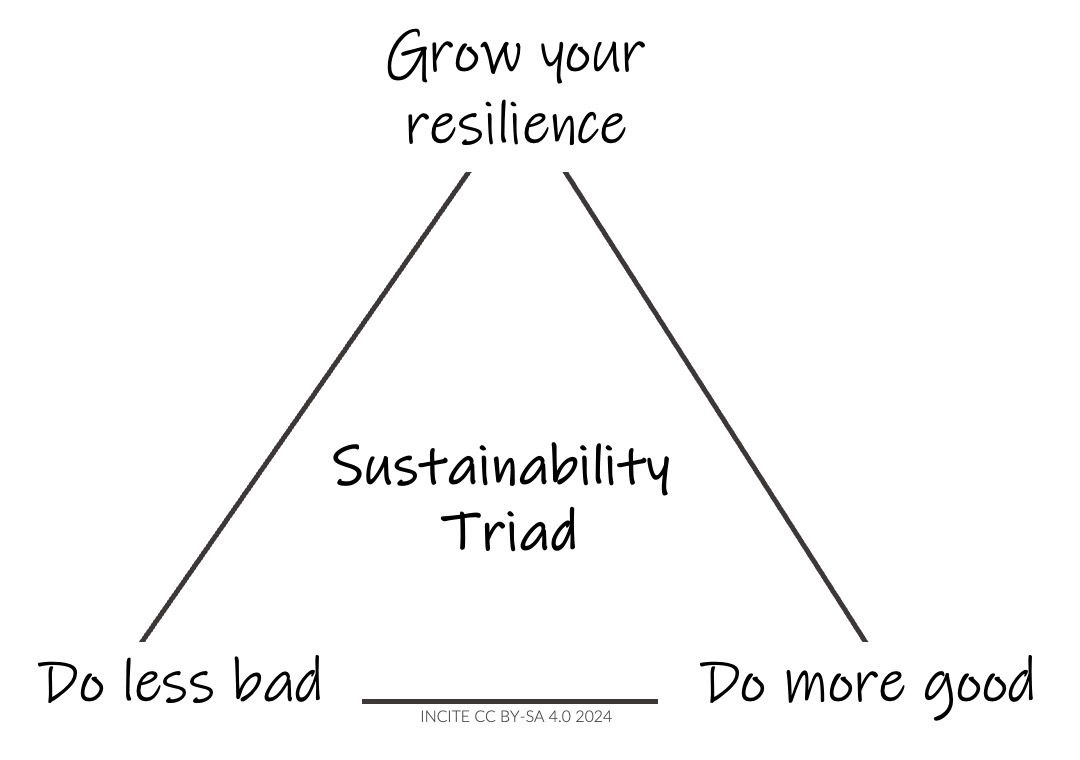
The updated version aligns quite well with the Sustainability Triad I posted earlier.

For those not familiar with Flexuous Curves, it combines Clayton Christensen’s S-Curves and Moore’s “Crossing the Chasm” (represented by the shaded areas). The initial enthusiasm for a novel approach hits a wobble as barriers to scale become apparent. When enthusiastic ‘early adopters’ run out, it enters a chasm. By the time mass adoption takes place, it replaces the previous orthodoxy although the original concept may have been compromised in the process. Where the curves intersect for the second time, those still following the old way are in the “last chance saloon” – in other words, they risk being left behind. (There’s much more to it than that, so read the Wiki to get the detail.)


Harm Reduction began in the 80s and is presently maintained through a large number of good/best practice frameworks and standards (ISO 14 000 series, etc). That number keeps growing by the week because this is where people make money off selling ‘the best way to do it’. Once the risk is adequately managed, there’s no need to track the latest fad. A decline in marginal returns and a rise in marginal costs yields diminishing returns, which present a natural barrier to novelty.

Innovative Win-Win approaches (Circular Economy, Base of the Pyramid, Reverse Innovation, Creating Shared Value, and so on) were intended to overcome this problem and get us to scale. Sustainability became more strategic. A few innovators got it right (there’s an example below), but ultimately talking far outweighed the walking. Some companies got overwhelmed by opportunity and struggled to focus; others gulped their own Kool-Aid and/or failed to manage the risk. The concepts live on in the minds of theorists and integrated reports, but the part about scale was conveniently forgotten. To all intents and (social) purposes, the Win-Win glow has faded.

I am also wondering whether there might be an inverse relationship between the size of the management consultancies entering the sustainability field and the likelihood of taking sustainable innovation effectively to scale. The Big Cs built their reputations on disruptive innovation, encapsulated in the idea of “big risks, big rewards”. Disclosure: I was once a  fan of blue sky thinking and disruptive innovation in pursuit of social purpose. Perhaps I’m just getting old, but my peers and I have been slogging along these curves for decades and I think we have come to a little wisdom. Innovating in highly uncertain contexts is risky, subject to unexpected failure and unpredictable things. Too damn often, it just doesn’t work. (Which is why the Win-Win glow has faded.)

Turning back to complexity science, a more risk averse approach involves exaptive innovation following the work of evolutionary biologists Stephen Jay Gould and Elisabeth Vrba. It is not the sexy kind of innovation touted by the Big Cs. (Of course, I think it is sexy.) Examples are emerging. South African financial services organisation Discovery Group launched Discovery Green last year in an attempt to extend and adapt (‘exapt’) their experience in incentive systems, big data capabilities, and stakeholder networks to help solve the electricity crisis in South Africa. They are a few years off delivery and will encounter barriers along the way. But risk management is another key capability of theirs, so if anyone is going to succeed at this, it is likely to be them. (More disclosure: I have worked with Discovery on and off for about a decade, though not on this particular project.)

My point is that scaling positive impact requires a careful and disciplined approach. Anything else in a highly uncertain context runs the risk of scaling unintended consequences that could more than offset the gains. Which brings us to the tendrils of a new sustainability era…

Resilience is reflected in the latest curve. It’s been around before but is edging closer to the mainstream now. I say ‘edging’ because while the word is tossed around like chaff, what it means remains a bit ‘out there’. (I use Snowden’s definition which is ‘survival with continuity of identity over time‘.) I think we are circling resilience by exploring parts of it, often identified by the prefix ‘re-‘: rethink, regeneration, restoration, redistribution, rehabitation, and so on.

If your organisation failed to fly with a Win-Win initiative, the learning curve for Resilience might be pretty steep. That’s because I think we’ve Entered the Chasm before resilience has fully become a thing. I am hoping to be proven wrong about that.

Either way, I think the ESG raters have been instrumental in the slide. They pushed sustainability up the boardroom agenda, but returned the primary focus to Harm Reduction (in this case, harm to their investments). In addition to ESG investing’s recent fall from grace, we see large companies dropping or diluting their social and environmental commitments. Amongst them: longstanding sustainability leader Unilever; global banks like Standard Chartered and HSBC; and fashion brand H&M.

People are wringing their hands or pointing their fingers about this. Some are giving up and heading for the hills.

I see it as good news.

We may be in the chasm but leading companies are not trying to Pollyanna their way across the top. In this way, it is different to the previous curve. Because purpose-washing wastes time that we no longer have. Resilience has never depended on ticking ESG scorecards or turning the screws on middle managers to meet sustainability ‘stretch’ targets. It takes us into a new arena – in the sense of worldviews – where we get into the ring with paradox.

As leading companies seek greater stability and transformative change, simultaneously, they will find themselves up against:

  • Jevon’s paradox, where improvements in the efficiency of resource use result in an overall increase in consumption;
  • What former governor of the Bank England Mark Carney called the “Tragedy of the Financial Horizons”; and
  • The inconvenient truth of Goodhart’s Law or “when a measure becomes a target, it ceases to be a good measure”.

We’ll need a new kind of fitness. A new game. And probably a new crew in our corner.

The sooner companies realise that, the better.

If sustainability is happening in your company, you can probably depict its role as a triad. (Triads are not just convenient triangles – here’s a snippet of history from others who have worked long and hard to present things in abject simplicity.)

I tested my triad earlier this week with a decidedly high-powered exec team, and it worked. That’s my primary test because, after a few decades of failed sustainability definitions, I know that how we present it to smart, cynical people who actually care matters. A lot.


It should be self-explanatory but my key take-outs on the triad are:

Sustainability can be usefully depicted as a set of vectors (i.e. things that have magnitude and direction).

This doesn’t mean that targets and norms don’t count, it just means there’s a higher-level theory of change that is going to take precedence. #vectorTOC

Sustainability does not consist of one vector, but three that inherently intersect.

Companies work on all three, simultaneously, with varying degrees of consciousness.

  • Almost all of them are trying to ‘do less bad’ because this vector is driven by explicit expectations. Think SDGs, ESG, CDP, and other acronyms.
  • Some are consciously trying to ‘do more good’ but the majority are struggling to scale the good part. Doing good is easy when we can fund it with a small fraction of net profit after tax. Once we get beyond philanthropy, we hit barriers to scale because our efforts slice into the externalities that drive the profit formula. This happens despite the win-win paradigm and sometimes even because of it. (One reason for this is that companies love the concept and can keep using names like ‘circular’ and ‘shared value’ even after their efforts have demonstrably failed to scale.)
  • Very few companies are getting their heads around how to ‘grow their resilience’. There are various reasons for this. Firstly, it is more complex than the other two. Secondly, direction is far from obvious at the outset. Thirdly, and probably most importantly, it requires working with something that is anathema to much of Western thought: paradox. Our most sincere efforts often turn back to bite us.

After 50 years of commitment to sustainable development, the vectors that matter are still accelerating in the wrong direction. The main reason, I think, is that we are really, really bad at doing all three at the same time. Unfortunately, we don’t have a choice on that part.

Far from despondent, and despite being less naive, I feel more hopeful than ever. We are starting to ride the current waves of urgency (which is likely to outlast the others) and people are developing new tools that are simple to use and tangibly making better decisions and actions more possible. That is part of what makes us people. We have a long legacy of getting it right, despite the fact that we have never managed to cross the chasm at this scale before.

Where would you position your company’s sustainability efforts on this triad? It’s fractal, so you can use it at any level.

This is obviously setting things up for deploying SenseMaker® in the sustainability space. I’ve been waiting for nearly three years to get going on this and it’s finally about to happen. I will keep you posted.

__

Banner picture cropped from a photo by Dušan veverkolog on Unsplash


Sustainability transition is about resilience. All three of these are tricky concepts, conceptually and practically, and I am not getting into definitions here. Nonetheless…

I’ve been tinkering with this 5A framework over the past few years and it is genuinely starting to support my work. Yip – no numbers and no arrows. The framework does not promise five simple steps to anything or anywhere. I have long since ceased to trust any simplistic framework.

  • Every organisation already addresses these elements – to some degree – whether consciously or not.
  • Organisations start with the element that appears to be the most useful place (which could be anywhere – it depends on what’s happening now in your organisation).
  • They typically work on several things in tandem.
  • What sustainability transition means becomes clearer along the way and depends on how we make sense of things.

Despite all this messiness, we invariably find it useful to track the transition effort on this framework.

For example:

  • The Exco is suddenly aware that ESG ratings are falling behind those of your peers: focus on Account, while tracking the other areas.
  • Sustainability integration is gaining traction, but there are hundreds of projects on the go and people are feeling overwhelmed: can you Align things a little better?
  • You’ve ticked the reasonable boxes and know intuitively it’s not enough: find funding to Accelerate your effort with safe-to-fail explorations.

Here’s the latest 5A framework:


The 5A framework is informed by the Cynefin Framework and other insights from Dave Snowden and The Cynefin Co.

___

Photo of tree in the banner pic is by Miikka A. on Unsplash


I’m often asked what makes a good Sustainability Lead(er). The answer – as usual – is that it depends. The criteria would differ depending on how the organisation understands sustainability and the organisational culture(s) that determine how things get done.

Most SLs find their jobs challenging. Geoff Marlow’s substack piece ‘Get a head and fall behind’ explains why many find their jobs damn near impossible. “Organisations have an unfortunate habit of appointing individuals to “Head of X” when “X” requires systemic change.” If pushed on capabilities, knowledge sets and personal qualities, I’d say that SLs need context, clarity, cynefin, connection and charisma. We are more likely to survive / succeed if we:

  1. Understand the organisation, the business model and its socio-ecological context (context)
  2. Understand what sustainability means – from compliance to resilience, and as much as possible in-between (clarity)
  3. Know the difference between complicated and complex challenges and how to approach them effectively (cynefin)
  4. Know how to work with formal and informal networks both inside and beyond the organisation (connection)
  5. Are able to attract attention and influence people (charisma).

Number five is indispensable and draws on my cross-training in an indigenous system that turned a dysfunctional cynic like me into something more useful for society. (Of course, humans have been working on their relationships with other people and nature for a long, long time.)

These five criteria would pertain to a CSO. They also apply to some “sustainability managers” because some organisations do not think the role through very well. If you’re employed as a manager and aspire to do more than tick boxes, you also need an understanding of power and agency, otherwise you will burn out. Sustainability consultants who help organisations improve thinking, decision-making and action must be able to learn fast to get up to speed on the company in question.

What have I missed?

__

Banner cropped from a photo by Guilherme Stecanella on Unsplash

“I found this systemic approach invaluable. Nicola supported me in my wish to hand over the organisation to new leadership with as little disruption as possible.”    Lisa Garson | Founder, Action Volunteers Africa

Have you ever used a coffee cup, a spoon and a saucer to explain something to a friend? You have simulated the system to make it simpler. We can use this approach to help individuals and teams understand the dynamics that prevent them from moving forward. It can also be used to test out options in a safe and controlled environment, before trying it in reality. Known as Organisational or Systemic Constellations, it is breakthrough method and highly valuable for organisations navigating sustainability transition. Here’s an overview of the process by John Whittington of Henley Business School.

Constellations draw on our innate ability to sense dynamics between things. They can be used to explore issues of leadership, strategy, structure and change, making tricky situations explicit and revealing options for moving forward. When working with organisational teams, we focus on roles and functions; when working with individuals, the session may include personal, family and ancestral relationships. Nicola uses them all the time in training and facilitation, but we can set up a specific constellation to address a particular problem or challenge. Find out more from Nicola.

In January 2023, an Insight Report appeared on the World Economic Forum website called ‘Embedding Indigenous Knowledge in the Conservation and Restoration of Landscapes’. The report was in collaboration with Deloitte and it sought to prioritise “the voice of nature and those Indigenous peoples who have spoken for it for millennia” (p4). It refers primarily to the Indigenous Knowledge Systems of Australia.

My respect for the Indigenous people of Australia did not come lightly. Twenty years ago, while consulting on-site for Argyle Diamond Mine, I was startled to hear what seemed to be the voice of the Mountain informing me that the land being mined was sacred. As a Yale-trained scientist, it was a difficult moment that I managed to force into the realm of ‘I did not actually hear that’. For a while at least. To cut a long story short, a three-year process of severe cognitive decline followed during which time I had to choose between Indigenous and Western psychological solutions to my problem. The mainstream solution involved a great deal of medication; the African solution (I had scuttled back to Africa after my experience) was to learn how to divine through an Indigenous Southern African training process that continues to this day.

Before I go further, let me respond to the Acknowledgement of Country in the upfront section of the report. I acknowledge the Indigenous Elder who welcomed me as a reader, Deen Sanders. Marrungbu – Thank you. I am from Africa, though I am a descendant of settler colonials and my ancestors descended from the Celts in Scotland and England. The lineage that accepted and trained me is that of Vondo which forms part of the Southern African tradition of Ngoma, which means ‘song’, ‘ritual’ or drum’. I offer my thoughts as a contribution and I believe that we both stand on the side of beauty.

I agree with and honour so many of the concepts shared in this report, including ideas such as ‘relational obligation’, ‘multigenerational responsibility’ and ‘fractal scalability’; the context is clear; and it is a compelling read. Yet I find myself wondering: Is it truly possible to prioritise the voice of nature and Indigenous people in this way?

I am not an IK expert; I am simply a practitioner who has no blood ties to the knowledge, but who walks the land and has remained in mentorship for more than two decades. My submission concerns not the content but rather the entire proposition and form of the report, which flies in the face of what virtually every Indigenous Knowledge holder and serious student knows: it is exceptionally difficult for someone trained in the North Atlantic paradigm to hear and act with integrity when they seek to apply or “include” Indigenous Knowledge. Indigenous Knowledge cannot be “embedded” by a WEF report; my concern is that is also risks being used as currency or paraded in the hope of capturing the attention of a society bereft of options that feel real.

The five-point action framework aligns with the consulting industry’s need for simple linear steps. In my view, investors can memorise, follow, celebrate, roll up and smoke it. The potential for those five steps to be “authentically embedded across the project lifecycle” is close to zero. Let’s pray that an ‘Indigenous Inside’ project certification scheme does not surface in the next few years.

How might we seek to “moderate or modify the reporting requirements attached to investment funding” when the framework is controlled by a paradigm that does not recognise spirits? Say, for example, I had wanted to add into my audit report for Argyle that the mountain told me that the diamond mine was on a sacred site. Where would I have put it? How might I have written it? Would there have been ears to hear? Twenty years later, are we likely to hear any better? Admittedly we are only asking investors to consider Indigenous Knowledge in the conservation and restoration of landscapes, not in how their investments destroy them in the first place. So that might be a little easier to get right.

After Argyle was sold to Rio Tinto in 2002 (enough said), I learnt that the local community began holding ‘Welcome’ ceremonies for visitors as part of a renegotiated agreement with the traditional owners. There is clearly politics around Welcome ceremonies as anthropologist Francesca Merlan suggests and which I don’t understand, but I for one would have been happy to be smoked and washed if it might have avoided a cognitive shutdown. Do you think it would have worked? Not according to my traditional mentor who told me straight that “We do not get to wash away the desecration of a sacred site”.

I was lucky to live in South Africa where remnants of the old cures for affliction by spirits still exist. I know that those who taught me would have great trouble imagining that Indigenous Knowledge can be authentically embedded in investment life cycles. Twenty years since I heard the mountain talk, I’m starting to explore the possibility of applying what I learnt in the organisational sustainability field. Even now, my ability to do this with integrity remains tenuous.

For too many of us, at Swiss mountain retreats or sweaty site-meetings, a momentary openness to Indigenous Knowledge gives way to cynicism and expedience. I wonder whether reports like these will validate the belief that, “At least we gave it our best shot”.

As the WEF report states, “the transactional process for exchanging knowledge that is commonly accepted within business, philanthropic and government systems is not fit-for-purpose when it comes to respecting Indigenous Knowledge systems”. The problem lies in Western knowledge systems that have all but destroyed indigenous science, along with indigenous law, politics, religions and above all economics.

___

Post script: This was one of my first posts on LinkedIn and the first time I’ve ever shared my views on Indigenous Knowledge. Within an hour of posting, an American who calls himself “The Organisational Justice Guy!” accused me of being paid by De Beers to oppose Indigenous Knowledge, and reminded me that my ancestors brutally destroyed IK and that “to equate IK with primitivism is racist at its core”. Just for the record, I was not paid by De Beers to make this post. I would have thought that was obvious. I am grateful for the guidance of  Dave Snowden who explained that using irony on public platforms carries the risk of being badly misunderstood. Neither Dave nor I could continue our engagement with The Organisational Justice Guy because we were blocked. I have since improved my understanding of how to write on public platforms and would probably write this differently were I to do it again; my views on the need to engage and the difficulty of applying Indigenous Knowledge in the context of modern organisations, including investment, remain unchanged.

___

Banner picture a composite of a screenshot from the cover of WEF Deloitte’s (2023) report and an image of Argyle Diamond Mine from https://commons.wikimedia.org/wiki/File:00_2192_Argyle_Diamond_Mine_-_Australien.jpg which is licensed under the Creative Commons Attribution-Share Alike 4.0.

This line from Dave Snowden has niggled me no end since I read it. Given that everything I’ve encountered of Dave’s thinking has proven to be remarkably useful in my work on sustainability integration, as well as pretty much everything else I do, ignoring it was not an option. I am also fairly intuitive and there’s nothing more irritating than knowing someone is right without knowing why. I have spent years telling my clients that one of the reasons that their integration process is hitting snags is a lack of clarity on their purpose.

I finally sorted out my problem. Things become fads because they have an energy about them; they carry some truth. They hold enough energy to modulate the system. Fads pass because they are only a facet of a truth. They are not seen sufficiently in context. It’s like falling in love with someone because they are smart. They may well be smart and I find smart attractive, but being smart is only one facet of how they think and that might not be enough to warrant my continued attention. When we recognise that what we see is only a facet, our attention moves to the bigger context and – if that can not hold us – we’ll find another attractor.

An organisation’s Purpose is a facet of a deeper truth. Vision is another facet of the same truth. We might call this deeper truth its ‘founding impulse’. This insight comes from Stephanie Hartung who is the founder of Constellations International. I am presently attending her course called #OCATO and it is undoubtedly the best full picture organisational training that I have ever attended.

The founding impulse is what gave birth to the organisation in the first place. Of course it will carry energy; it is creation expressed in a new organisation. When an organisation loses its connection with that impulse, it lacks something that informs its ability to be in the world. When an organisation is clear on what brought it into being, it has a strength. That’s why Sinek’s ‘Find your why’ is so popular. But that power comes from initial conditions, not a sudden surge of social conscience (or something more cynical) that leads an organisation to declare its purpose as some variation of saving the world.

The past matters because it brought us to where we are now.

Where we are now is all we have to work with.

What we call it doesn’t matter as much as what it is.

How we express it might change.

Take a deeper look at what it is and decide whether your current purpose is useful.

I’ve heard Dave Snowden suggest that executives are trapped in a Stockholm syndrome relationship with their HR/OD functions. I am starting to think this might apply in the case of their ESG ratings agencies too.

Stockholm syndrome is a coping mechanism in which people develop positive feelings toward their captors or abusers over time. Other symptoms are similar to post-traumatic stress disorder and include:

  • Flashbacks
  • Feeling distrustful, irritated, jittery or anxious
  • An inability to relax or enjoy things that you previously enjoyed
  • Trouble concentrating.

Hm.

Stockholm syndrome isn’t recognised as an official psychological condition in the DSM and there’s no standard treatment. Talk therapy is recommended to:

  • Understand your experience
  • Understand how sympathetic behaviour toward your captors was a survival skill
  • Learn how you can move forward with your life.

I don’t think these recommendations are useful under the circumstances.

In my opinion, active engagement is recommended to:

  • Realise that ESG shows only one facet of the sustainability spectrum
  • Appreciate that ESG raters could be trapped in their own syndromes
  • Develop a context-based view to inform your next step.

ESG is a standardised hygiene factor. Context-based sustainability includes ESG but is more nuanced and strategic.

__

Photo cropped from an original by Timothy Dykes on Unsplash


Once sustainability practitioners get over that pervasive view of three interlocking circles (society, environment, economy), many of us settle in to see our territory as three complex adaptive systems (business, society, nature) nested one within the other. Our field is inherently complex. That does not mean that all decisions taken at our organisation’s intersect with society and nature are complex decisions. It doesn’t mean that the tools we use help us make sense of complexity. My practice took a step forward when I got clear on these points and why they matter. How we approach any decision will differ depending on the context. Is it clear, complicated, complex or chaotic? This simple question changes everything.

The Cynefin framework of five domains was developed in 2007 by Dave Snowden to support anyone grappling with this uncomfortable truth. This means most of us because virtually every field is grappling with complexity right now. Snowden has refined it significantly (the most recent version is pictured below) and I doubt you’ll find a better overarching framework to inform any sustainability related decision. I’m gently exposing my seven-year-old to the idea, but it’s never too late for any practitioner to embrace a new tool. If Cynefin was more widely appreciated within our field, it may have lifted the tenor of some of the more exasperating debates, such as Creating Shared Value vs Corporate Social Responsibility, Sustainability vs ESG, and other protracted debacles.


Let’s take your carbon footprint as an example. That’s an issue at the complex intersect with nature, though of course it has social implications. (Complex = highly interconnected, though you’d never know it from the ease with which some investors champion carbon reduction over its social implications.)

Imagine you want to know your personal carbon footprint. It is clear. You Google a footprint calculator, type in your details and voilà. There’s no easier way.

Now imagine you want to calculate the footprint of a large organisation. This is likely to get complicated. You will definitely need a good practice guideline such as the Greenhouse Gas Protocol and it might be wise to engage a consultant to help you. With a little analysis and rational thought, you will have a good enough approximation.

Now imagine your board discovers that TCFD carries a fiduciary duty and they may be personally liable if the organisation can’t show they are taking this footprint seriously. The union was just informed of a proposal to mechanise an aspect of your operation to reduce said footprint, with possible job losses along the way. They simultaneously put pressure on Exco who send a directive to your boss. Your boss (who knows sweet nothing about carbon footprints though you wouldn’t think so by the way he talks) calls you in. The situation just got complex. Make a move in one direction and the union will react in the other. Slow things down and some individual on the board will start squeezing your boss. Your boss fears being shown up for his ignorance and ups the ante. On you. Maybe. We never know quite what they’re going to do. And that’s the point. That’s complexity. Make a small careful move. Watch what happens. Then decide your next step.

Now imagine that it’s a month before the TCFD report is due to be published and the Head of IT informs you that the carbon data you’ve collated over four painful months has been terminally corrupted. That’s chaos. Act immediately and decisively. Do whatever is needed to restore a modicum of sanity to yourself and the situation. If it works, you’ve taken things back into one of the other domains and you can proceed accordingly.

And the fifth domain? That’s when you don’t know what domain you’re in. Confusion. Make a cup of tea, breathe. Becoming aware that you don’t know might help it to become clearer soon.

Since discovering Cynefin belatedly during lockdown, it’s changed how I think about almost everything. Once we start using it, the framework makes more and more sense and, happily, so do we. As a complexity aware practitioner, I wouldn’t get up in the morning without it.

___

Banner pic adapted from Future Fit Methodology Guide (2019) available at: https://futurefitbusiness.org/benchmark-documents/

Cynefin® is Welsh for a “Place of Your Multiple Belongings” and if you’re interested in African philosophy its logic is easy to grasp. Find out more at https://cynefin.io/wiki/Cynefin. If its breakthrough implications are not obvious to you, the best starting place is the Cynefin Basecamp.

“It’s been fantastic. I could carry on all night. ” Senior Analyst at Just Share, at the end of a full-day facilitated strategy review.

In traditional Africa, leadership was dialogic and collective; the shade of the Big Tree made conversation possible no matter how heated the subject. Dialogue still plays a critical role in sustainability integration.

Facilitating dialogue requires more than just getting people in a room together. We live in a culture that is mechanised, digitised and optimised for performance. This makes dialogue seem messy and inconvenient. This may be true but without genuine dialogue, transition will simply not be deep enough and your organisation will pay the price later.

Effective dialogues are highly designed but the outcome is not controlled. Getting this balance right requires experience. Using decades of experience, we have helped:

  • Shareholder activists Just Share review their strategy with their board and team
  • The Global Reporting Initiative facilitate leadership dialogues across the Middle East and North Africa
  • Shell and Deutsche Bank hear what their stakeholders actually think
  • Hundred of organisational teams see how their sustainability efforts help them to activate their humanity.

Our processes keep minds engaged through tacking tough questions, using embodied processes, exploring the underlying dynamics, and adopting a systemic view. We frequently use simulation to make this easy for all participants.

Contact Jonathon or Nicola to see how dialogue might help you find a way forward.


I’ve just returned from five days with my family at Siyama Homestead in Gaborone, Botswana. Siyama would probably be called my spiritual home. It was where I was initiated into the Majoye sangoma lineage more than two decades ago. Here, I reconnect in person with the land and its history. With the people who live here and who eat food grown on the land. With those who have mentored me over 20 years and with others who share this place as their spiritual home. And with visitors from surrounding areas who are part of the same lineage.

The simple practice of connection is essential to our work as sustainability practitioners. The more complex our challenges, the more essential our embodied connection becomes. It helps us engage with clients, access the energy that informs our thinking and develop new perspectives that support our work. Deep connection in a special place supports our ability to connect anywhere: in mountains or the kelp forest, in townships or boardrooms. We all connect otherwise we would not be alive. Without it, we are lost; we risk burnout.

Where do you connect in a deeper way? How is it working for you? To make it a conscious practice can be useful for us because our work is fundamentally about reconnection. You may already do this, but if not, these steps may be useful.

1. Think about where you feel at home. Where some essential part of you feels familiar. It may be your home, the church or mosque, a particular place in nature. It may be many of these or other places you did not expect.

2. Take yourself there. Now, soon, later this year. Alone or with family or friends. By doing this repeatedly, we establish a rhythm. What is the cadence of your return? Make the pathway between you and this place explicit.

3. Balance the exchange. Reflect on what this place gives you. Give something back of equal or greater value.

___

Photo credit: Siyama Project

Sometimes the last thing we need is more information, tools or workshops.

We want something that reminds us why we do this work.

Nature-based coaching is not a luxury or a way to escape reality. It is a critical part of our practice.

Give us some notice and we will shift your coaching session into nature. With a little more time, we can design and facilitate a bespoke two-day session with your team in a deep nature setting.

We currently run nature-based coaching only within the Cape Peninsula (Cape Peninsula National Park and Silvermine Nature Reserve). We work with partners to facilitate deep wilderness or cultural immersions (five-days minimum) in other parts of Southern Africa.

Please contact Nicola.

Photo of Venus Pools, Cape Peninsula National Park, by Lisa Garson.

The big push to integrate Sustainability/ESG into the core business is well underway. While it’s possible to pursue integration using approaches that bridge to next era thinking (more about that here), many companies are already finding it tough to get traction with their current toolset. Working as a thinking partner across every sector makes it fairly easy to see patterns in what holds this process back.

Here are five barriers to Sustainability/ESG integration. Each interferes in its own way with your company’s ability to embrace its potential to create positive social or environmental impact, at scale. Prompted by Andreas Richter on LinkedIn, I’ve added my general strategies for overcoming them.

  1. Pigeon-holing: “Sustainability is a compliance or marketing function.” At its most pernicious, this is familiarity bias: we assume Sustainability is part of something we know to make it less overwhelming.
    Strategy: Wait it out. Trying to overcome this barrier can lead to additional problems. Integration can start anywhere; get ready for the long haul.
  2. Trade-off mentality: “Investments in Sustainability/ESG will require trade-offs on margin or profitability.”
    Strategy: Evidence. Use case study data to show that, while trade-offs are inevitable in some cases, this is not true in all cases. Knowing the difference will impact the success of your strategy and can turn detractors into champions overnight.
  3. Expedience: “Investor ratings scorecards make a good strategic framework for Sustainability.” This is less easy to overcome. The current investor awakening means that any Sustainability framing other than E-S-G must navigate a steep incline.
    Strategy: Scheduling. Get the ESG ratings up first. When that stress drops down the agenda, people see the obvious more easily.
  4. Complacency: “Sustainability/ESG has been core to our business from the start.” This is usually paired with pigeon-holing in the marketing function. It is beyond boring to work with because proponents agree with whatever you say without changing their line.
    Strategy: Courage. You risk a career limiting move, but just get real.
  5. Hubris: Sustainability/ESG is for suckers who don’t see the bigger picture. Proponents are often contrarians who have seen their ‘bigger picture’ view emerge victorious on a previous occasion. This is possibly the most difficult barrier to sort out because clever egos are invested in keeping it in place.
    Strategy: Trickster. Agree with them. Then laugh and shake your head. Make them nervous you know something they don’t.

The question is not “Do these barriers apply in my company?”. It is “Where do I see these barriers applying and how am I responding?”. My strategies are not a recipe for success, but may help keep you sane in the meantime.

___

Banner image cropped from a photo by Marcel Strauß on Unsplash

Sustainability Practitioners are constantly exposed to their organisation’s Intersect with society and nature. We notice the dynamics and relationships at play almost without realising it. We forget how overwhelming it can be for colleagues with other day jobs. We get frustrated when they ‘don’t get it’. The problem is not them, it is us. We understand more than we think we do. If we are not aware of this cognitive bias, often called Unknown Knowns, it impacts our effectiveness as practitioners.

My own bias became obvious when I was working on Profit-Enabled Impact with alcoholic beverages company Distell. I naturally gravitate towards Sustainability initiatives that have potential for scale and always assumed others did too. Carin Fouche, Distell’s strategy lead, had listed their Sustainability initiatives in a 2×2 that made it easy to see the difference between initiatives that deliver profit-enabled impact and everything else.

I’ve reworked it a bit, but this is essentially her framework. It makes explicit the tacit knowledge that many practitioners don’t realise they have.


The matrix categorises initiatives according to their potential for scaled social/environmental impact (x-axis) and the degree to which they leverage key capabilities or assets of the organisation (y-axis). The examples below all focus on the same issue: climate change. (Many organisations use disclosure frameworks to do strategy. This is another cognitive bias at play and you can read more about those here. The description below should clarify why dividing up your initiatives into E-S-G may limit your strategic thinking.) In no particular order:

  1. Philanthropic initiatives are low scale and low leverage. They are extremely important to the people they seek to support. They protect value through positive brand association, but don’t create value for the organisation. A climate example might be planting trees to create shade and beautify a local crèche.
  2. ESG compliance and risk management draws on key capabilities and a significant amount of time, but the impact of these initiatives is unlikely to scale at the organisational level. This is because there are diminishing returns for an organisation to go beyond a certain point, so we’ll withdraw the resources as soon as we’ve dropped our risk to an acceptable level. These kinds of initiatives also protect value, but don’t create it. A climate example might be calculating, reducing and disclosing our carbon footprint.
  3. Profit-Enabled Impact happens when sustainability initiatives are scaled through the business model. These require us to leverage key capabilities and assets. They will either increase revenues, decrease costs or tangibly improve the business ecosystem, or combination of these, over time. Their direct connection to the profit formula drives scale. This creates value all round: the bigger we get, the greater the positive impact. A climate example might be a transition to renewable energy across the entire operation.
  4. Advocacy and collection action initiatives scale through external partnerships rather than through the business model. These are low leverage in terms of assets and capabilities, but tend to leverage the respect and gravitas of a senior leader. They may enable value creation through first mover advantage or by encouraging stakeholders to work together on systemic threats to the entire market ecosystem.  A climate example might be the retail CEO’s open letter to President Cyril Ramaphosa on South Africa’s energy crisis.

We are constantly trying to make sense of our Intersect, so typologies can be useful. Of course, this is not the only way we categorise our initiatives. We slice our organisation’s portfolio of initiatives into E – S – G to meet investor expectations; we assign initiatives to the functional areas that are responsible for managing them; or we divide them up based on whether we are starting, maintaining or exiting them. Each of these approaches can be useful depending on the context. I like Carin’s approach for strategy work because it keeps us focused on value rather than values.

As always, a few notes from the frontline:

  • Strategy seeks scale and leverage. Use this tool to analyse your distribution of effort in respect of protecting, creating and enabling value. This delivers insight into your organisation’s current and future potential, as well as how much learning you may need to do along the way.
  • Avoid category blinkers. Initiatives can start in one quadrant and move to another. For example, Anglo American adopted a partnership approach to develop nuGenTM, a zero-emissions haulage solution. When its competitive potential became evident, it moved into the Profit-Enabled Impact quadrant.
  • Positive impact can be reinforced by connecting up initiatives across these four quadrants. How might philanthropic initiatives do two jobs simultaneously: for example, tick the Broad-based Black Economic Empowerment box and pilot Profit-Enabled Impact that may be scaled through the business model in the future? We always look for multi-functionality in complexity and ticking the box on BBBEE does not mean you’re fronting.
  • As we coordinate our portfolio, we increase our ability to gather intel that will improve risk and opportunity detection at the Intersect. This is our entry point into greater resilience. It is what long-term investors should be starting to track, but more on that later.

How might you use this framework to support more strategic thinking when working with your teams?

___

Banner image cropped from an original photo by Luca Martini on Unsplash

If our organisation is for-profit, sustainability strategy must take cognisance of  its relationship to profit. One of the ways to do this is through a concept we call Profit-Enabled Impact. This is Incite’s word for Shared Value (see Porter and Kramer, 2011). I opted for Profit-Enabled Impact because I got tired of people calling it ‘Shared Values’ and heading down avenues that were important but helped teams validate their inclination to skirt the business model.  Many people use the term Shared Value describe initiatives that are far from what its originators had in mind. A couple of months ago, I encountered an organisation – they even had ‘Shared Value’ in their name – touting philanthropy as an example of Shared Value. It was inappropriate to argue at the time but it pushed me into making the difference explicit. If we do strategic sustainability without engaging the business model directly, we are not yet in the starting blocks.

So, Profit-Enabled Impact it was. A bit in your face, but it makes a tactical point. I use the abbreviation PEI and I often talk about PEI patterns. I pronounce this ‘pay patterns’ to remind people that we’re talking about money, or more generously the idea of ‘pay it forward’. The concept is quite simple and it’s best explained using a typology of sustainability initiatives. When we are clear what it is not, we are probably also clear what it is.

This is a technical post and focuses on the process of PEI pattern analysis. By following these steps, you should be able to develop your own set of PEI patterns, if you’re the adventurous type.

Step 1. Context. First, ask why you want a set of PEI patterns. For example, you may want to:

  • Identify relevant PEI patterns to help focus your strategic framework
  • Identify PEI patterns to guide your ideation in respect of a particular challenge (e.g. supply chain localisation)
  • Compare how your local peers are faring in the profit-enabled space
  • Explore how global leaders are innovating to deliver profit-enabled impact
  • Develop a leading indicator to supplement the ESG ratings of the companies in your investment portfolio, etc.

Your answer to the ‘why’ question will help you determine:

  1. The peer companies to include in your analysis – this is your ‘territory’; and
  2. How granular you may need to get.

Let’s imagine you’re in the ICT sector and you want to identify a broad set of PEI patterns that will help you progress strategic integration of Sustainability in your decisions and actions.

Step 2. Internal review. Start with your own company. Where are examples of PEI already emerging? They won’t be called that in your report. The people you speak to probably won’t even see them as ‘sustainability’. That’s why you’re doing this! Order a set of generic Ideator cards to help you and the team if you’re struggling.

A quick review of your Integrated and Sustainability Report, together with a range of conversations, may reveal that your colleagues across the business are already:

  • Using a digital platform to sell micro-products like loans and health insurance. You might name this pattern ‘Micro-products‘.
  • Selling data via informal spaza shops in the township areas. ‘Micro-entrepreneurs‘.
  • Investing in ‘last mile’ connectivity in rural areas. You might name this pattern ‘Underserved areas‘.
  • Finding ways to offer freemium services as a way to grow market share. You might name this ‘Freemium‘ or ‘Differential pricing‘.
  • Training young black sales agents. ‘Skills development‘ or ‘Inclusive sales team‘.

Identify as many patterns as possible, with as many examples you can find of each pattern. Names are important, but don’t sweat over what you call the patterns at this stage.

Step 3. Peer analysis. Do the same thing using the disclosure reports of your identified peer companies. You’ve already been naming patterns, so it will get faster and you can improve the names as you go along. The number of patterns will increase. If you end up with too many (for the purposes of your process), you may want to scale back the level of granularity you’re working at. Iterate and improve. If you intend to compare yourself against peers, keep track of who is exploring what. It’s messy, but that’s the way of things in complex systems.

Step 4. BM receptors. Identify where the patterns might find traction within your existing business model. Think of these as possible connections like receptors in a cell or within your neural network. Here, they offer an opportunity to test a given pattern in your business. You can use Incite’s PEI Canvas to help you. If someone on the team can’t put into words how a given pattern might increase your revenues, reduce your costs and/or enhance the surrounding ecosystem, then put it aside and go on to the next pattern. Don’t worry about silly-sounding ideas – someone else might not think them so silly. And don’t throw away the ones you put aside: keep them for the next time you do the analysis. Where you actually decide to place the pattern on the PEI canvas is not that important. Different people will see different receptor sites. This is a good thing.

Step 5. Working PEI pattern set. Aim to identify up to 15 PEI patterns that have potential to deliver profit-enabled impact for your business. Clean up your list, write short (one sentence) descriptors for each pattern and think about how best to present them. A name, a photo/image and one example for each pattern is useful. Too many examples and you risk getting too messy again. Highlight those you are already exploring. Run a comparative analysis to see which of your peers are exploring more broadly and position your own company. (If they are not leaning in already, this will generally do the trick.)

A few tips from the frontline:

  • Doing is knowing. The team doing the analysis is going to get very familiar with these patterns (all humans have an innate pattern recognition capability). But the team you may share them with has not activated this capability in the same way as you. I learnt that the hard way several years ago when I shared what I thought was a break-through set of patterns that Incite had generated for an ICT client: an uncomfortable silence was followed by a pointed query about where this lay in the terms of reference. I quickly learnt how to make the analytical process more inclusive and focused on bridging anyone not directly involved in the process. Since that time, I have steadfastly refused to accept any TOR that required me to follow a set process.
  • Potential is not the same as actual. We are using patterns to get one step closer to better allocation of effort. This might simply be the leaning in of executives. The next step might be to train them how to use this tool themselves and to engage a lot more people in the process. To deliver the actual impact at scale, we need to ideate and prototype, which is another thing entirely. The point of PEI patterns is to make small safe-to-fail investments that are a little more likely to succeed. Small victories matter if we are honest about what they are.
  • Be creative in how you use them. A basic set of patterns can be used in many ways to support strategic integration of Sustainability in your company. I learn something every time I do this analysis. Please share your experience.


____

Photo composite cropped from originals by Ricardo Viana and Markus Spiske, both on Unsplash


The big ESG pushback is sparking useful self-reflection in the Sustainability field. Here’s a view on the evolution of our field since its formal inception in the nineties. It applies Dave Snowden’s Flexuous Curves framework and ‘back-of-the-napkin’ sketch to the paradigms informing Sustainability practice. Flexuous Curves brings together ideas like Apex Predator, Keystone theory and Moore’s Chasm in the product space. It shows how something novel emerges and gains traction with those frustrated by the dominant paradigm.

Sustainability practice initially focused on doing less bad. Companies leading the charge had more to worry about: BP, Shell, Dow, Du Pont. In 1995, Shell’s Brent Spar incident epitomised society’s frustration with the harm reduction approach as the company was widely considered to be a Sustainability leader. This is my marker for the start of the new ‘Sustainability integration’ paradigm. Around that time I started my first job as Sustainability manager for Nissan South Africa, so much of my career has focused on this challenge.

The integration era brought new Sustainability leaders, including Unilever, M&S, GE and Natura. But enthusiasm for a new approach is difficult to maintain. In this case, most people are still grappling with what Sustainability means; most consultants are still promoting what their current tools are designed to fix; etc. So, we see the adoption curve dropping down into the classic ‘Moore’s Chasm’. Around this time the branding agencies embarked on an all-out embrace of the marketing opportunity in ‘good and green’. Goodness pushed the movement into the values (rather than value) space, with many executives assuming that trade-offs were required on their profit margin. For many years to come, this would impact companies’ ability to see Sustainability as a strategic opportunity as well as a risk.

In 2010, we saw BP’s Deepwater Horizon oil spill. I’ve placed that to mark what Snowden calls the ‘last chance saloon’ for the harm reduction era, although the 2008/9 global financial crash had already done the heavy lifting. At this stage, it is finally clear to everyone that something is needed beyond harm reduction. This coincided with Porter and Kramer’s (2011) article on Creating Shared Value, with field politics spiking in its wake. You can see why: Sustainability practitioners had started exploring the concept well before Porter and Kramer scooped the brand in Harvard Business Review, but much of that energy was focused on addressing what was holding the movement back.

Within a few years, the mainstream began to align behind the era of integration, driving a new upward curve. Impacts rippled across conference titles, guidance documents and consultants’ service offerings. Organisations still clinging to the old compliance era now risked oblivion as capital began to find its feet in the integration movement. Enter early stage taxonomies for sustainable investment. Here, Snowden makes a critical point: “The dominant player does not fail because they were incompetent, but because they were too competent in the old paradigm and that very competence means the inattentional blindness is writ large into the very fabric of the organisation.”

The <IR> Framework published by the International Integrated Reporting Council (IIRC) in 2013 was another key development at this time. Nearly a decade later, the IIRC would join with the Sustainability Accounting Standards Board (SASB) to become known as the Value Reporting Foundation. This set the stage for mainstream pushback against the greenwash that flowed from the marketing embrace.

In their book All In: The Future of Business Leadership (2018), Grayson, Coulter and Lee see the purpose-led business as another era. To my mind, purpose-led approaches are still in pursuit of strategic integration, they just focus on the opportunity within the risk. Snowden sees purpose as a fad. I initially disagreed but now I’m not so sure. Either way, I still see it as part of the integration era. I’ve been working on how to get companies beyond a singular focus on ESG risk for ten years and my Profit-Enabled Impact patterns are finally helping our clients grapple with opportunities in a real way. I am hoping that PEI patterns will make it easier for late adopters to move more quickly on integration too.

Which brings us to today. Spurred by the pandemic, the regenerative era has arrived in the interim and I’ll let you do the word searches to validate that. Suitably forewarned, we can expect the chasm to be wide and deep. The stakes are higher now and this will reflect in the dynamics. Mirroring the brand agencies an era ago, the investors have fully hopped on board and this makes a difference. Our challenge now is that most of the players in the ESG investment space are still prioritising data flows that reflect the harm reduction and early stage integration (i.e risk or pre-purpose) eras. One reason is that it’s easier to standardise risk across sectors than to focus on how companies innovate to address them. Standardisation makes comparison possible and it lets machines do the job. (Along with climate tunnel vision in the global North, this is what I lose sleep over.)

Although the current ESG pushback has clear political overtones, some form of resistance was inevitable because the investor approach is not taking sufficient account of where the bigger system is headed. In other words, ESG analytics are currently limited by the assumption that what worked in the past (a dogged focus on short term risk reinforced by the discount rate and accelerated by digital valuation models) will work in the future. Once (or if) enough investors get over that assumption, things will really get interesting.

So, although regenerative business is a popular idea and will make it into brand statements and media claims, I think most companies are far from coming to terms with what it means in practice. Sustainability veteran Jonathon Porritt bemoaned this point a year ago in his blog Regeneration Made Real. Quoting Snowden again: “A general strategy to get [across the chasm] with an upwards trajectory is what I call a symbiotic strategy in which the novel capability is made an apparently insignificant additional aspect of convention…”.

What might a symbiotic strategy look like for your organisation or your approach as a practitioner?

___

The Flexuous Curves sketch is informed by: https://www.aglx.com/evolving-naval-safety-an-apex-predator-approach/; Grayson, Coulter & Lee (2018 ) All In: The Future of Business Leadership and Volans (2013) Project Breakthrough. Volan remains a go-to sources for smart thinking in this field.

Banner photo by Jason Leung on Unsplash

I walk the littoral most mornings. After dropping our daughter Kim at school, I have an hour to just be with what makes me human. The beach ebbs and flows. Waves bring offerings. Sometimes shells, a dead sea bird. The lady from the church is doing her daily litter round. Dog-walkers. Two girls in blue school uniform taking the day off for who knows what. Walking on the beach feels important. It inspired this guided meditation I sometimes use with teams or groups. What I say changes depending on who I’m working with or a client’s particular Intersect, but the essence is largely the same.

Sit comfortably. Take a minute to become aware of your body. Notice the parts of you that touch your clothes, the chair, the floor. Take a few slow breaths. Allow each out breath to drop you a little deeper. Let that which is not you drop away.

Imagine you are walking on the beach. Notice how it is. The sand. The seaweed. The wet and dry. How high did the sea come today? Waves breaking. Smaller waves reaching to the shore. Walk slowly and look around. The dead things. The alive things. Things left by people. Things left by the sea. Anything. Just notice.

Now the beach leads you into an imaginary place where your organisation touches, overlaps with society and nature. It’s distinct. It’s familiar although perhaps you have not encountered it in this way. There’s a customer asking about your products. Maybe she’s worried about organics or over-packaging. There’s the receptionist you sometimes greet in the morning. Her children are home from school and are having tea and bread. No jam this close to payday. You nod if she sees you. You walk on. The CEO’s car is parked on the left. Perhaps you’ll bump into him up ahead. His driver is leaning against the car, scrolling for messages. Up ahead, three women are separating and stacking boxes for recycling. Their small business partners with your logistics operation. Keeps things neat, usually. The owner is laughing, talking in Xhosa about something but you don’t understand. Beyond that a small group of men stand at the side of the road. They have paint brushes ready in case of a job. On a TV screen at the electronics shop across the road, a local activist is talking about climate change. A banker cuts in to talk up green bonds. You sigh. And walk on.

Up ahead is a small thicket of trees. You find a path and the air cools as you enter. You notice the branches and leaves. The movement of birds. The smell of earth. You walk.  Up ahead is a small clearing. The sun is warm but dappled. You head for the centre and sit in the warmth. The space feels welcoming. You relax. And breathe.

You notice some way off that someone is coming. Perhaps from the present, perhaps the past, perhaps the future. Or an animal even. They are moving slowly towards you. There’s no hurry, just movement. They reach the edge of the clearing and you can see them now. They come to you. They bring something. A message. Perhaps a memory, an idea, a gift. A few words. Stay quiet and see if you can hear or see what it is. It’s fleeting, but whatever you remember is right. Hold onto what came to you. It could be anything or just a part of it. Whether it is important or not is of no consequence. Just remember.

They are leaving now and you bow a little inside for whatever they brought. Watch them go. It’s time for you to go back too. You head slowly back along the path. The leaves, the soil, the birds, the colours. You walk through the Intersect and across the beach. You are back where you started, but you have something more.

Become aware of your fingers and your toes. Slowly stretch. Come back to your body. Come back to here and now. Open your eyes.

As always, what we do with gifts is up to us.

___

Banner photos takenlast week on my morning walk at Glencairn Beach

Patterns help us make sense of the world. Humans have an innate capacity for pattern recognition present from birth. Patterns in colour, texture, shape and sound help us to recognise faces, distinguish words and convey meaning. This basic cognitive process can go wrong as I discovered in 1999. On a consulting job for Argyle Diamonds (now Rio Tinto) in Australia, I started hearing and seeing things that were, shall we say, not relevant to the situation at hand. Imagine walking across the mine site and hearing what the mountain thought about the extraction underway. Real or not, it was irrelevant to the context, inherently untestable and deeply unsettling. I omitted the unusual intel from Argyle’s report, but things deteriorated when I got back to South Africa. I struggled for three years to control a rampant stream of data that had no evident purpose, turning eventually to an old indigenous cure. The training involves rituals that would not have broad appeal, but it locates an on-off switch to get the rational mind back in charge. The option was infinitely better than what my psychologist was offering at the time.

Anyway, that was my introduction to patterns in cognition and Sustainability practice. I learnt the value of pattern-seeking years later when I read Snowden and Boone’s article on the Cynefin Framework. When we do Sustainability strategy, we work with complexity. In this context, no one knows what the future is going to look like: cause and effect can only be deduced in retrospect. We can’t follow best practice or rationalise our way forward, but patterns can help us make sense of what’s emerging. Strategists make use of patterns all the time: market patterns, customer behaviour patterns and competitive patterns. My patterns showed how peers were scaling positive social or environmental impact through the business model.

In the face of a jungle, evolution has taught us to look for patterns. Can you see the pattern below? (Screenshot and idea clipped from Joel Glanzberg‘s website at patternmind.org).


It’s not arithmetical. It’s not morse. It’s not linked to do-re-mi, as one training delegate suggested. It’s simpler than that. (Answer: The letters on the upper line consist of all straight lines and those on the lower line all contain curves. Despite my rough introduction, I did not crack the pattern and no one in my teaching sessions has managed to date. This will probably change because I use Fieldnotes to back up my training and coaching sessions. If you read it here, please don’t answer.)

Once we see a pattern, it’s obvious. Before that, it’s a jumble and irritating when others see it before we do. A company’s intersect with society and the environment is messy. While business leaders generally know the preferable direction for a social/environmental trend, getting the core business to contribute to that is not so obvious. Insight into profit-enabled impact (PEI) patterns helps my clients clarify their next step forward or what The Cynefin Co calls the Frozen II approach to strategy.

In organisations, we improve our pattern-enabled insight through diverse perspectives (i.e. engaging with people who don’t think like we do). Like machines, we improve pattern recognition by seeding the mind’s eye with examples. A good tool could help us do both. This was the idea behind Ideator which is a pattern-based facilitation tool for Sustainability strategy, ideation and awareness. Check it out!

___

Banner image cropped from a photo by MagicPattern on Unsplash

Businesses have scaled negative social and environmental impacts through their profit formulas for centuries. While not their fundamental purpose, getting society to pay – directly or indirectly – for the health effects of smoking, fossil fuel emissions or the consequences of the migrant labour system has delivered immense rewards for some. As pushback by stakeholders and nature increases, companies are getting seriaaass about improving decision-making at their intersect with society and nature.

To reduce or offset their social and environmental impact, companies comply with legislation. They develop policies. They deliver ESG data to investors and donate a fraction of profits to charity. All good, but these things don’t scale. Porter and Kramer’s 2011 article on ‘Creating Shared Value’ opened a few doors, but movement has been painfully slow. One reason is the assumption that positive social/environmental impact must incur a tradeoff on profitability (not necessarily true). Another is that the leverage points for profit-enabled impact are not obvious.

Over the past decade, I’ve noticed recurring elements in business initiatives that deliver tangible social/environmental impact while tangibly enhancing the profit formula. I called them Profit-Enabled Impact (PEI) patterns. Patterns can be useful in complex systems. By organising overwhelming amounts of information into patterns of recurring elements or features, we can make complexity easier to understand. Learning more about applied complexity (my late discovery during Covid) helped me turn PEI patterns into a useful tool. You can also read about Ideator – a tool that supports PEI awareness and ideation – here. The rest of this post focuses on the patterns and how we came to work with them.

All PEI patterns have the potential to deliver positive social/environmental outcomes, but how a pattern is applied depends on the particular context. They might occur in different sectors geographies or parts of the value chain, but some fundamental element is repeated and that is the basis of the pattern. PEI patterns are activated through the core business. They are not about corporate largesse and all have demonstrated potential for increasing profitability in the short or medium term. This potential unleashes commercial genius – case by case – in pursuit of scalable social/environmental impact. The positive impact scales as the business grows. If another company can do it better, it probably will. Profit and competitive behaviour re-emerges from the naughty corner as a potential enabler of scaled positive social and environmental impact. At least that’s the idea; what happens in practice is another story.

Examples show how simple this concept is. By engaging micro-entrepreneurs, companies may become more inclusive of previously excluded groups (positive social impact). They may also develop new sales channels or supplier networks (positive impact on profit). Multinational consumer goods company Unilever engages micro-entrepreneurs (‘Shakti Ammas’) to sell its products in villages in India. Brewer AB Inbev engages micro-entrepreneurs to grow and sell barley in Uganda. Different contexts, different sectors, different geographies, but the activating element is the same: Micro-preneurs.

Whether or not the initiatives actually improve profitability or deliver positive social impact depends on many things. Hindustan Unilever’s Shakti initiative scaled to become part of the mainstream business, and led their growth during Covid. I stand to be corrected, but I suspect a quiet discussion with AB Inbev is likely to solicit a less enthusiastic report on their experience with micro-growers. Different context, different capabilities, different outcomes. Tangible evidence of outcomes is often lacking, but we still tag a scalable PEI initiative if it appears in the annual reporting cycle. In our experience public disclosure is enough to indicate that the pattern has potential and it’s a better starting point than something entirely new. (We can discuss the value of radical innovation some other time. I’ve got older and wiser and Snowden’s insight on this point has convinced me that radical repurposing is a better approach all round.)

Over the years, our team has developed a working knowledge of about 50 high-level PEI patterns. (I’m into helping machines take over this job, which would allow us humans to get on with more fun stuff. Watch this space.) For the time being, we personally scan many, many peer disclosures to identify the top 10+1 patterns most relevant to our client. 10+1 is an arbitrary number, but it’s a useful upper limit for first time exposure. The main point at this stage is to get teams to notice PEI patterns themselves, at which point they lean-in to their collective value chain insights and loving hearts.

Product-as-a Service was an early PEI pattern. Xerox pioneered it – before it became a pattern – in the late 1950s. By renting rather than selling photocopiers, Xerox customers benefitted from greater flexibility, lower operating costs and zero capital outlay. Long term customer relationships delivered tangible financial returns to Xerox. The positive environmental impact lay in improved productivity: by retaining ownership of the asset, Xerox had an incentive to keep it operational for longer and to recycle used parts. Both value stream are measurable, and the impact scales as the business grows. Of course more resources are still being consumed, but it’s a meaningful tweak in the matrix. Hilti did something similar with tools, Castrol does the same with fluid management. Fleet rentals appear to follow a similar pattern, but look again. Fleet rental solutions usually involve a partnership with financial institutions who take ownership of the asset. If the producer does not retain ownership, the social affordability might increase but the environmental impact may be a lost opportunity. Not necessarily; as ever, it depends.

Once we understand PEI patterns, we notice them all over the place:

  • Rematerialisation: Afrisam’s Eco-cement uses recovered waste – slag – in a hybrid product to lower its costs and carbon footprint. Coca-Cola’s marine bottle – made with recycled marine plastics – does something similar.
  • Raw material substitution: AB Inbev applies this pattern in Uganda too, substituting cassava for traditional hops and barley. Cape Town-based food tech company Freddy Hirsch make use of locally available, sustainable raw materials in alginate sausage casings – derived from kelp – helping global B2B customers replace animal products in their brands. (Given the plant-based food trend and the juicy fact that Americans alone consume 20 billion hot dogs every year, that’s impressive growth potential for a family-owned business.)
  • Intermediate products: Canadian petroleum company Frontera Energy uses water extracted from their Colombian mines to supply irrigation water to local communities. This pattern inspired teams at local alcohol brands company Distell to consider how snails harvested from their vineyards might be used for mucin production, an ingredient in beauty products. Intermediate products is the primary pattern, but the Distell team quickly recognised the opportunities for engaging Micro-preneurs in the process. Environmental impact can potentially expand to social impact.

As Distell discovered, primary PEI patterns usually open the space for secondary and tertiary patterns to increase potential impact. This is what The Cynefin Co calls exaptation (think expand and adapt) and it motivated Distell to use Ideator to develop one of their brand strategies. When patterns combine along the value chain, we anticipate accelerated learning because someone or some team within the company is seeing with pattern-mind.

Companies can extend or adapt their own PEI patterns to increase impact and accelerate growth. Discovery built its health insurance business on a PEI pattern we call Behaviour change. By incentivising customers to become healthier, the Vitality model tangibly reduces claims, increasing the cash available for innovation. The pattern underpinned their global growth strategy, with the Vitality chassis sliding into place for every partnership and joint venture (including their 25% partnership with the Ping An Group of China through Ping An Health). Discovery recently exapted their core behaviour change pattern by committing to launch climate-related product offerings in South Africa and the United Kingdom by 2023. They’re old hands at behaviour change, but carbon is another ballgame. Let’s see if they get it right.

 ____

Banner image is of Tra Que village in Vietnam, cropped from a photo by Rod Long on Unsplash.

I’m happy to say that this post is the subject of more requests than I can count on one hand. Incite’s Ideator is a facilitation tool that develops literacy in positive Profit-Enabled Impact (PEI). It’s based on our innate human pattern recognition ability and I think it’s unique within our field, though please let me know if I’m wrong. If the idea of PEI patterns is new to you, you can get some background here.

Essentially, Ideator can be used to improve the literacy of any team on PEI. This literacy can be applied to support thinking in many instances, from ideation to branding, purpose activation, creating a more inclusive culture and so on. Ideator is Incite’s first attempt at a genuinely complexity-adapted tool. It is informed by the Cynefin framework that distinguishes between an ordered context (where we can apply good/best practice and consult experts if it’s not clear to us) and a complex one (where we can only look at emerging practice and require more playful learning).

We have three kinds of Ideator: Generic, Sector and Bespoke.

Generic Ideator is applicable to any organisation. It shares a broad range of fairly high-level patterns, usually for Sustainability awareness and team building. It consists of:

  • Nine environmental pattern cards, highlighting basic ways in which organisations are delivering profit-enabled environmental impact through their business models
  • Nine social pattern cards, doing the same thing for social impact
  • Nine tech enabler cards, highlighting various digital, physical and bio-technologies that are being used to scale the relevant impact.

Each of the above is paired with at least one example card.

Sector Ideator works at a finer level of granularity. Drawing on the high-level patterns and sector-based research, it finetunes a carefully-named set of up to 15 patterns that are finding traction within a given sector. This is useful for Strategic Alignment and for supporting PEI ideation with any team.

Bespoke Ideator is a set of patterns specifically developed for a specific client and purpose. The requisite level of granularity will depend on the purpose. Recent bespoke Ideator sets have focused on circular economy opportunities (mining sector) and patterns that offer opportunities for empowering women across the value chain (food sector).

In Ideator processes, participants use the cards – singly or in combination – to catalyse their own thinking about what might deliver PEI anywhere along the value chain. How we choose to play depends on what our client is seeking: a PEI portfolio for strategic investment; greater Sustainability awareness; impact-oriented brands; culture alignment for M&As, etc. I’m confident that we’ve only scratched the surface on potential applications.

Generic Ideator is a good starting point for awareness and basic PEI pattern literacy. Sector and Bespoke Ideator sets cost more. The more granular we get, the more granular the patterns that come into perspective. Too granular, and we might lose sight of patterns that have potential value. Once we have data on the PEI patterns being explored by competitors, we can use analytics to rank their efforts and explore where they might be taking their strategy. (I’m a strategist at heart and sometimes have to be reminded not to bad-mouth disclosure. Jon generally obliges and he’s right of course because without mandatory public disclosure, PEI pattern analysis and Ideator packs would not be possible.)

Our original Ideator comprised seven basic steps. Once we got familiar with the method, we starting playing around, omitting and adding steps, depending on the specific task and time constraints. The whole point of the game is to improve creativity – in the approach as much as the outcomes. Our original seven steps were:

Step 1. Clarify the context. Why are we doing this session? What’s happening in the company, the broader environment, the minds of the participants?

Step 2. Provide a task. Ideally this is real or plausible within the organisation and for the players. Make it a bit edgy.

Step 3. Sketch the business model. The business model offers the most direct routes to scaling positive environmental/social impact. The profit formula has successfully scaled many negative impacts over the years and anyone familiar with indigenous spiritual processes knows that the way forward requires us to use the problem rather than suppress it. Find our Ideator-compatible business model canvas here.

Step 4. Introduce the Ideator canvas. Also referred to as the profit-enabled impact (PEI) canvas, this shows how three big pathways for PEI map directly onto the business model. Although Incite developed this canvas, it draws on the high-level pathways originally identified by Porter and Kramer in 2011. These refer to initiatives that are tangible and potentially scalable. They include:

  • Initiatives that deliver tangible social/environmental impact and increase revenues, typically through new products, services or markets
  • Initiatives that deliver tangible social/environmental impact and reduce costs, typically through productivity improvements
  • Initiatives that deliver tangible social/environmental impact and enhance the delivery system, typically through ecosystem improvements.

Step 5. Introduce the patterns. Hand out the Ideator pattern cards. It’s not necessary to explain where the patterns come from. They are simple enough for employees to get the basic idea and team members will share their insights with others. Use Ideator’s example cards to stimulate discussion, allowing the teams to become more familiar with the concept. They will generally work it out. If you’re using the PEI canvas (Step 4), explain how the patterns might enhance the respective elements of the business model. This is colour-coded on the cards, so it’s easy to see and remember. The more difficult part is getting participants to stop assuming that these are hard and fast categories. Many patterns impact more than one aspect of the business model and people see different aspects. At this stage, it doesn’t matter what aspect is highlighted and what category the team decides to put it in.

Step 6. Set the timer, remind the teams of the task and let ideation begin. There is no one way to play Ideator. It’s a creative tool for facilitators who draw on their own skills and insights to co-design the experience. Depending on the context, Incite facilitators might:

  • Use only one pattern card per small group; only one example card per small group; all cards for everyone at once; or any combination.
  • Do competitive speed rounds (2 minutes each)
  • Divide teams in different ways (e.g. oldest vs youngest, longest time in the company vs shortest time in the company, male vs female)
  • Offer a prize for the silliest idea (many people find this extremely challenging, even impossible, which is illuminating in itself).

Step 7. Debrief in accordance with the context. The game may be an end in itself (awareness and team-building) or it may be followed by formal prioritisation processes (strategic portfolio) and safe-to-fail prototypes.

We strongly advocate for diversity in any Ideator run. With Ideator, people with the relevant experience – for example, in how underserved communities might best be served – are not simply plumbed for their knowledge but engage actively in the process. We can run Ideator in 1.5 hours (that’s the minimum). We’ve also run it over a full day and over several consecutive one-hour sessions on-line. Online has obviously been taking precedence of late and our latest generic deck is due a reprint.

Ideator is generally time well spent. It can also be used in conjunction with other activities to help catalyse more insights. Next time the employee volunteer unit sets out to plant trees or paint the local crèche, add Ideator into the day. Engage stakeholders from outside the company in the process. Ideator is about stimulating new thinking, informed by diverse perspectives, starting from the current business model and building on what we have (or is already emerging in adjacent systems).

The end point depends on the players and their networks. Let’s play.

___

Banner photo: Employees of a mining company in Namibia using Ideator as part of a Cambridge Institute for Sustainability Leadership training.


The terms ‘sustainability’ and ‘ESG’ are used in different ways in the literature and in organisations.

In some ways, this makes our work as sustainability practitioners exceptionally hard. In other ways, the fact that there are no universally agreed definitions for key terms is a useful constraint. It forces us to clarify what they mean in relation to our particular context which is always a good thing when what you are dealing with is emergent.

I reflect on what these terms mean for every organisation I engage. My starting points for these reflections are as follows:

  • ESG and sustainability both seek better decisions and action in relation to society and nature in order to reduce negative impacts and improve organisational resilience.
  • The term ‘sustainability’ is more commonly used in a broad sense. Sustainability is multi-horizon in scope (short, medium and long term) and considers aspects pertaining both to the organisation and to its broadest set of stakeholders (including society as a whole). This broader scope recognises that issues material to a given organisation’s operation and strategy can arise from beyond the narrower set of stakeholders formally engaged by an organisation.
  • The term ‘ESG’ is used primarily by the investment community. It typically refers to a subset of sustainability aspects, and specifically to those that have a financially material impact on the organisation’s cash flow over a reasonable period, but not the long-term. This approach does not consider society as a whole to be a material stakeholder. Accordingly, it focuses only on those parts of society that are directly related to the value proposition of the organisation (its funders, employees, customers, suppliers and so on).

The conceptual difference between sustainability and ESG is small but the politics generated by this difference is not. It split the global community seeking to ‘harmonise’ investor ESG disclosure requirements. Although the IFRS and their ISSB won the day with the issuance of the “sustainability” (actually ESG) disclosure standards in June 2023, the debate is not over and receded only somewhat when the ISSB signed a memorandum of understanding with the more broadly-scoped Global Reporting Initiative in March 2022.

As you explore what these terms mean for your organisation – and whether the difference is actually material beyond your core practitioner team, which I doubt – consider keeping an eye on the following:

  • ESG has rapidly become the dominant view (follow the money) but not all stakeholders agree that it is the better way to think about integrating sustainability into organisational decisions and actions
  • A broader ‘sustainability’ view can be useful if early detection of sustainability risk is important
  • Standardisation of ESG disclosure has increased the fiduciary duties of executives and boards, along with the organisation’s short term risk of non-delivery on disclosure
  • While standardisation is necessary to prevent diverging disclosure expectations from deteriorating into chaos, important local nuances will be lost in the global drive
  • Addressing ESG disclosure requirements is a necessary focus but not a sufficient one from a competitive strategy point of view. More on this later in ‘Do investors score an own goal with ESG?’.

I will happily admit that my initial response to the rise of ESG investment was to use the terms synonymously. This was tactical because the difference felt too nuanced to be useful and any word with six syllables is a bad way to open discussion with busy executives. Jon and I disagreed and I now incline towards his view. (Space for disagreements makes Incite a fun place to work.) While I start every engagement by briefly discussing the difference, I am clear that using the terms interchangeably is not a crime if the level of nuance is not relevant to the task at hand.

Fortunately, most of my work falls into this category so I am gently sliding back to my old habits.

__

Banner image is a cropped composite of photos by Jon Tyson and by Viktor Vasicsek, both from Unsplash

ANGLO AMERICAN, GREEN BUILDING COUNCIL, ISO, UNRISD, WOOLWORTHS

Talking leads to doing when inspiration and insight are delivered, simultaneously. Whatever the occasion, if sustainability perspectives are needed, we can help you make it work.

Nearly 20 years ago, Jonathon led the 2005 global multi-stakeholder negotiations for the development of the ISO 26000 Guidance on Social Responsibility. The process secured consensus – from more than 450 experts, 95 countries and 45 global organisations – on the principles and guidance for organisational governance, human rights, fair labour practices, the environment and consumer rights.

Jon and Nicola bring slightly different perspectives but are equally able to ‘shift the dial’ in any organisational context. Clients engage us because we speak our minds but back it up with meaningful data and real stories. We are cynical about the lack of progress over 50 years but still passionate about finding better ways forward. We have worked on the shopfloor. We appreciate that executives and leaders at every level face tough decisions in highly uncertain times. After nearly three decades of sustainability practice, we are starting to understand a bit about how organisations work.

  • Incite keynotes have inspired PPS, Woolies, Anglo American and the Green Building Convention.
  • We help design and facilitate events e.g. Global CSR retreats in Geneva and Bangkok for UNCTAD and GIZ
  • We facilitate expert discussions e.g. for Paris-based UNEP Industry and Environment Centre and UNRISD
  • We moderate at conferences e.g. for the Global Child Forum, Global Compact Network South Africa and CRES (Corporate Responsibility to Eliminate the Sale of Children).

Whether you have space for 10 minutes or 10 days, we can be there. Email Jonathon or Nicola to discuss what might be useful.

Incite’s VIROS blends five lines of analysis to help practitioners and teams make sense of their organisation’s intersect with society and nature.  It is basic, simple and high-level; it should be adapted to use whatever analysis already exists for your organisation. It has a strategic orientation, by which I mean it is concerned with how an organisation might seek to allocate its effort or attention. We’ve tested it over a decade and we don’t facilitate many processes without running through VIROS first.

Used in reporting processes, it provides insight into the material issues that are likely to inform your stakeholders’ decision-making (i.e. it is a materiality analysis). In strategy processes, it provides a foundation for more granular work needed to inform better sustainability thinking and action. VIROS  analysis typically informs a facilitated process that draws on the collective intelligence of every participant in the room.


Here’s a simple user’s guide:

Value creation

Create an explicit diagram of your organisation’s business model. This is how you create value. If you don’t understand something about that, you have little insight into how to work with impact. Incite’s business model canvas is based on Clayton Christensen’s classic thinking. Use whatever model works for you but avoid the IIRC’s octopus business model which is designed to tie you in knots.

Impacts and dependencies

Think at the value chain level i.e. upstream, midstream, downstream. Use the six capitals (FYI originally five capitals developed by Jonathon Porritt in his 2005 book Capitalism: As If the World Matters) to sketch out:

  • Dependencies: Elements drawn from various capital stocks/flows that are needed/relied on for value protection / creation. For example, your company needs access to skills in order to operate. Those skills may be abundant, under threat or in short supply, in which case they may represent a risk.
  • Impacts: What happens to capital stocks/flows as a result of what your company or others (including nature) do. For example, skills development might impact a broader whole such as the sector. By targeting your skills development, you might increase your access to skills needed to address the risk.

The important part is getting into an informed discussion on which of them might be considered more important. That requires understanding of both your organisation and society. No one really knows how to do that but many people will sell you a method. The basic approach here: consultants will never enough to tell you. Find a way to tap the experience and expertise that lies within your teams. Leave your impacts and dependency analysis at a messy level; it will never be perfect.

Risks

If you are a large corporate, the risk team has already identified the top risks. Approach that analysis from the perspective of sustainability i.e. considering the organisation’s alignment with society and nature. Sustainability-related risks are often hidden between the lines of the top risks; sometimes the top risks have forgotten to consider this aspect (although since the investors pushed sustainability into the mainstream, this is happening less often).

Opportunities

Here, we typically apply a bespoke line of analysis called Profit-Enabled Impact. This provides insight into areas where your organisation has greater potential for scaling positive impact on society and nature, based on emerging patterns.

Stakeholder perspectives

This is an important element if you are using VIROS to inform your disclosure. It is advisable to avoid firing up Survey Monkey and sending it to all the stakeholders on your database. This is likely to be ineffective for many reasons, not least survey fatigue. To deep dive here, we are open to the distributed ethnography approach of The Cynefin Co called SenseMaker®. If your appetite for stakeholder engagement is limited, we zoom in on the disclosure expectations of the investment community. This is because they are the key target audience for your report.

VILROS may seem a bit overwhelming at first. But with some preparation, you can cover the basics – enjoyably – in a single conversation with an executive team in about two hours. As with most methods, results and enjoyment improve with practice.


___

Banner picture (cropped from a photo by John Mark Arnold on Unsplash) refers to being clear about our level of granularity, because it matters.

Incite has not been accused of blowing its own trumpet. At least, not yet and not overtly. But parampara (what is the sound of a trumpet??), our first sustainability practitioner retreat (27-29 October 2022) was a blast! Three days at secluded Mont Fleur, where mountain fynbos meets the Stellenbosch vineyards; twenty senior practitioners who are actively navigating the travails and heady attention of the explosion of interest in our field; going beyond technicalities into their deeper experiences of frustration, insight and resolve. It felt human and connected. We reconnected with old friends and made new ones. Judging by the feedback, it was what we all needed.

Sessions explored emerging trends within the broader sustainability field, within our organisations and for us as practitioners. The field is mainstreaming, professionalising, commoditising, politicising. It demands chunks of our time just to stay informed. It’s given rise to overnight ESG experts, in all shapes and sizes. Tracey Davies, known for her incisive candour as director of shareholder activist organisation, Just Share, quotes a common comeback from the companies she cajoles: “Just let me tell you two things Tracey: this stuff is complex and there are trade-offs.” Really?

Organisations are reframing their sense of what sustainability leads do. A new hotline has opened to the C-suite, often recently awakened to deafening noise. Stuck in the midst of escalating pressure, uncertainties and a paucity of decision-useful data (despite thousands of ESG ‘indicators’), some resort to simplistic pleas: “just give me one thing to focus on for E, S and G”.  Others lean forward and ask the questions long awaited by us practitioner types. There are tough questions all round. “There’s more willingness to engage on climate change now,” says Tracey, “but corporate South Africa is still clueless – clueless – on inequality.” And if SA is clueless on this, there’s less hope for the rest of the world.

Practitioners are tired, yet far from ready to step aside. Jess Schulschenk, director of The Sustainability Institute, speaks about ‘strategic champions’ who go above and beyond, repurposing the dominant narratives that hold us back. She speaks of ‘sacred activism’ reflected in new methods. Things slow down for one of them: an intense systemic process. Delegates represent elements within an organisation, helping its incoming CEO to reflect more deeply on his passage. Immersive and profoundly trusting, they provide embodied feedback as small, safe-to-fail probes are dropped into what appears to be a tense standoff. At last, a simple shift allows us all to breathe again. Ahh, something new is revealed and the next small step is evident.

Jon Hanks reflects on Incite’s 20 years of using disclosure to engage listed corporates on systemic challenges. Peers smile knowingly: using disclosure as the entry point for something more is the reason most of us are still at it after all these years. There have been shifts, but in truth, we expected more. From South African businesses, from stakeholders, from ourselves. We explore complicity and the price we’ve been prepared to pay for access. Naïve or not, tomorrow we’ll have one more conversation with an executive, a board, a practitioner that lands with the gentle thud of consequence. Perhaps.

That evening, Jon Duncan, who trail-blazed Responsible Investment for OMIGSA, dials in from Geneva where he now works to chat about the global investor ESG landscape. Reflections are mulled over local wines: a shift in the global debate from shareholder primacy vs ‘shared value’ to a two-pronged discussion on short termism vs long termism and rate of growth vs quality of growth; youth as an impending force for change; things hotting up on biodiversity; and the mobilisation of global capital underway.

C words surface again and again. From complicity to complexity as an excuse for inaction. How do we separate out what can reasonably be standardised into ‘good practice’ from developments that require constant sense-making to find the insights we need? How do we approach innovation in complex systems? Using Incite’s Ideator, delegates explore scalable opportunities for profit-enabled impact. Ideator (CC BY-SA 2.0 ZA) is a learning tool that uses pattern recognition in an attempt to make business innovation more inclusive. Challenged to share the silliest ideas, we find ourselves entrained in our seriousness. Let’s go and eat. Mont Fleur food and hospitality is outstanding.

We end on a decidedly practical note. How to grow a new kind of practitioner network that supports us personally and organisationally, with a meta-view on our field. We want to engage in high-level debate today, deep wilderness immersion tomorrow, and silly banter over local vinos in-between. Could Incite use its brand, network and experience to support a distinct praxis – a merging of theory and practice – in support the shifts we seek? Taken aback and pleased by a strong vote of peer confidence, Jon and I agree to rethink Incite’s offerings accordingly. And to meet again next year for sure.

____

Inserts by Sonja Niederhumer of Graphic Harvest. Inciter-turned-graphic artist, Sonja quietly absorbs every word, sifts the gems and delivers an fabulous graphic reflection of the dialogue.